


Home
The Fusion Urban Games Festival in Matera from 31 October to 2 November
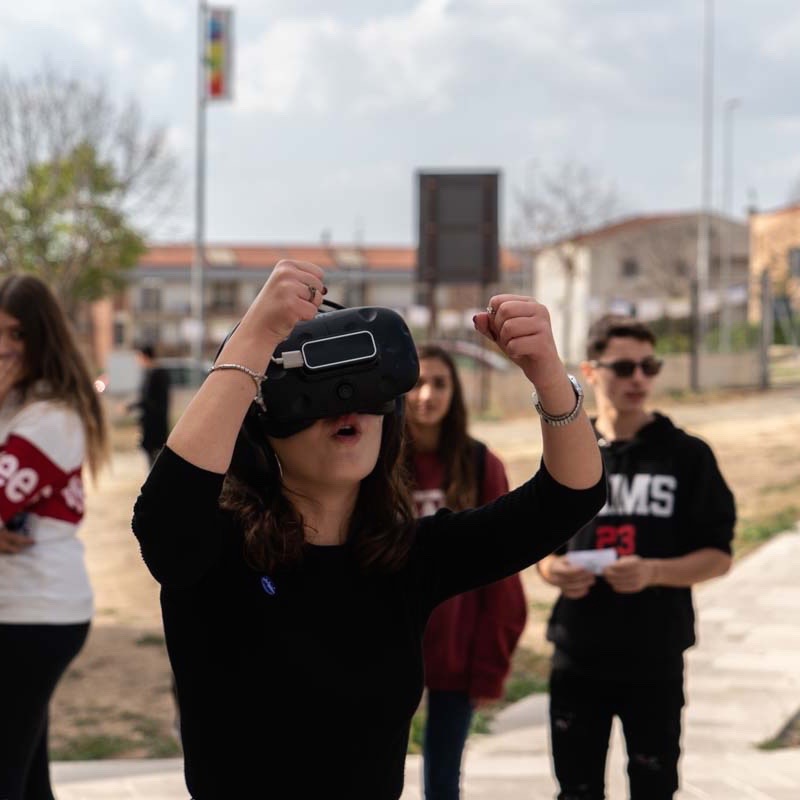
From 31 October to 2 November, through 15 different games, citizens of all ages had the chance to explore secret corners of the city, look for clues, solve mysteries, work together and compete, challenging other players and trying to come out on top.
The Fusion Urban Games Festival used virtual reality to inject new life into urban spaces and help participants rediscover traditional games through encounters with ghosts, porcelain dolls and strange personalities looking for gems and tails, the mystery of the death of CountTramontano, ecological tasks and urban poetry. The festival, which was produced with Plovdiv 2019, the other European Capital of Culture, was three days of pure enjoyment, and also part of a larger joint programme of activities called “Plotera weeks – Plovdiv and Matera together for an Open Future”. The games were designed by a team of game designers chosen from a public call published across Europe that rewarded projects from Russia, Poland, Bulgaria, Germany, England, Slovenia, Romania and Italy. From its first day, the Fusion Urban Game Festival's playing field included the outskirts of Matera, including Serra Venerdì, for the game dedicated to ecology called the "Clean Game" and Agna Le Piane and Casino Padula, the location of the Open Design School, where one of the two Villages dedicated to the event was set up. Here, using a special VR set, participants were able to immerse themselves in virtual reality while they hunted for the ghosts of legendary personalities with their smartphones. There were also sessions of ancient games that were unknown to digital natives. During the same period, another part of the Village was established in Piazza San Francesco, the central point from which the routes followed by some of the games started and an info point for temporary and permanent citizens alike where they could register for some of the games and find information and promotional materials on Matera's twin European Capital of Culture, Plovdiv 2019. The games on offer included "Detective among the Sassi", a fascinating game for lovers of thrillers, who had to use a series of clues to discover who was responsible for the death of Count Tramontano in 1514. There was also the "Case of the Red Lady", the "Narrative Puzzle" and the "Urban Poem", which fully involved the participants in the festival of urban games. The urban game known as "Penombra", an "international" version of the project co-produced with the "Il Vagabondo" Association, also caused excitement with its journey into a dystopian future of Matera in 2119, which was transformed, divided and under a mysterious threat.
After Matera, the festival was also held in Plovdiv from 8 to 10 November, confirmation that it was an important tool for social activation and territorial inclusion for both cities.
The Land of Cockaigne, the fourth exhibition put on by I-DEA
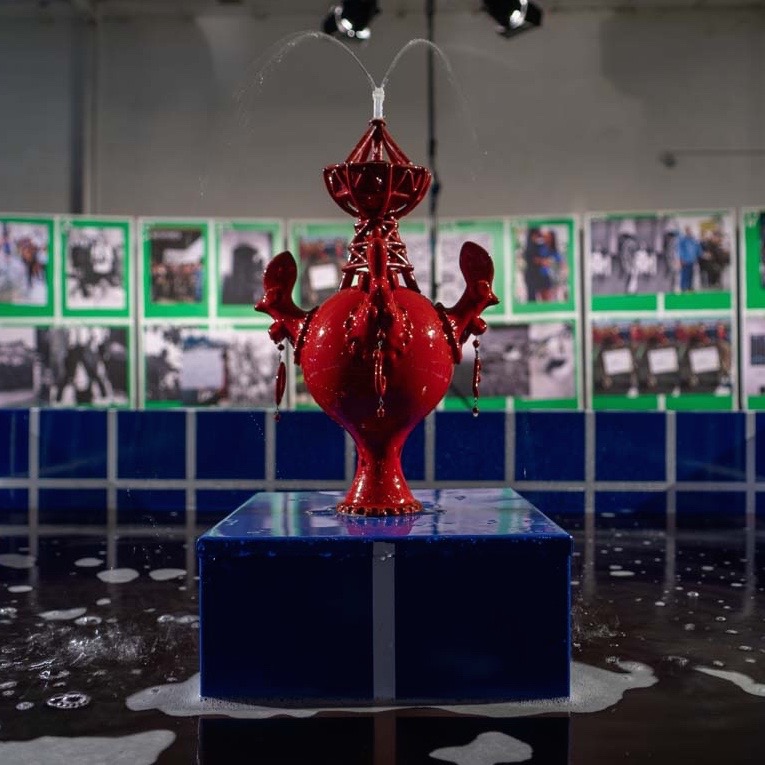
Stories, legends and fantastic characters returned to life in the fourth exhibition put on by I-DEA,
"The Land of Cockaigne", curated by Navine G. Khan-Dossos and James Bridle. The exhibition
was an artistic project based on Basilicata's extremely rich archival heritage, and told the story of
the role of imagination in our lives. It was opened in the hangar at Cava Paradiso on 18 October,
and bore witness to the great vivaciousness of the history that has given life to Matera and Basilicata, and how it still has a major impact on our lives today. From musical instruments built
with wood from its trees, to skins and the green screens from cinema sets, the fourth I-DEA
exhibition put the many symbols of the land and its meanings on display. From the donkey
Nicoletta, the symbol of the anti-nuclear protests in Scanzano, portrayed by Tony Vece in a
number of photographs in the exhibition, to artefacts made by citizens in papier maché workshops
under the coordination of artisan Raffaele Pentasuglia. Navine G. Khan-Dossos and James Bridle
also left a number of precious elements from the previous exhibitions-including Lionetti's
engravings and Luigi di Gianni's films- in the space, which was designed by Elisa Giuliano, Martha
Schwindling and Antonio Elettrico for the Open Design School.
Following “The Land of Cockaigne”, I-DEA will be preparing for another transitional phase from 18
November before putting on its fifth and final exhibition of 2019, "Inhabiting the Archives, Life,
Movement and Collection". This is the final stage of the project, and takes the form of an exhibition
curated by Pelin Tan and Liam Gillick. The project is based on archives selected as part of the
research carried out by the internationally renowned curator and the artist, and represents a critical
approach to modernism, in line with the history of the territory from the 1950s to today.
The “Land of Cockaigne” draws on the ancient, the living and the future. Inspired by the spirit of
Cockaigne, the curators have brought together ancient plants and modern forgeries, pre-war
documentaries and modern successes, bagpipes and satellites and science and rituals with the
aim of demonstrating the many ways in which the wealth of the present gives new life to the past.
The exhibition has been drawn from numerous different archives, from the Accademia Nazionale di
Santa Cecilia, the Archivio di Etnomusicologia, the Agenzia Spaziale Italiana, the Centro di Geodesia Spaziale Giuseppe Colombo, the Archivio Domenico Notarangelo, the Archivio Luchino
Visconti, the Fondazione Gramsci, the Archivio di Stato di Matera, the Alberico Larato private
collection, the Gianfranco Lionetti private collection, the Nicola Scaldaferri private collection, the
Consorzio di Bonifica della Basilicata, e-GEOS, the Fondazione Cineteca di Bologna, NASA, the
Volontari della Parrocchia B.V.M. del Carmelo, Wikimedia Commons and Titanus Film. A fountain
with a cuckoo sculpture designed and created by Francesco Mitarotonda has also been prepared
specifically for the exhibition.
Invisible Pavilions
- Project Leader/Coproduzione/Ecc.:
Co-produced by
SoutHeritage Foundation - Immagine progetto:
- Facebook:
- Twitter:
- Instagram:
- Project Partners:
Human ecosystems, Italy
Museo per la fotografia “Pino Settanni”, Italy
ENSA National Art School of Art, France
Global Grand Central, Sweden
BAICR - cultura della relazione, Italy
Fondazione Filiberto Menna, Italy
Fondazione Sinisgalli, Italy
Associazione Giovani Unesco Basilicata, Italy
- Artists:
Riccardo Arena, Italy
Eric Aupol, France
Bianco Valente, Italy
Tomaso Binga, Italy
Thomas Bontemps, France
Monica Bonvicini, Italy
Giuseppe Fanizza, Italy
Yona Friedman, Hungary
Andrew Friend, Great Britain
Peter Fischli & David Weiss, Switzerland
Ferenc Gróf, Hungary
Kyo-Hyun Kim, South Corea
Gustav Metzger, Germany
Maurizio Mochetti, Italy
Clara Noseda, France
Renzo Piano , Italy
Angelo Vermeulen, Germany - Evento:
- Campo aggiuntivo 5:
Supported by BCC Basilicata

The excavated subterranean architecture and the extensive system of cisterns in the Sassi area represent the visual, spatial and structural element that has established the city of Matera as a World Heritage Site.
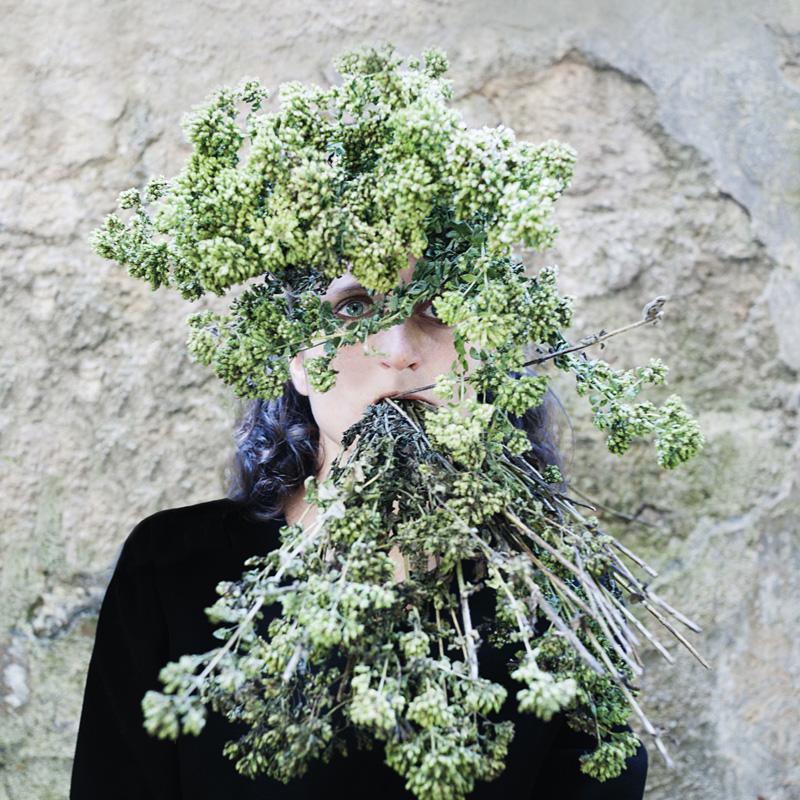
AltoFest Matera Basilicata 2019
- Project Leader/Coproduzione/Ecc.:
Co-produced by
TeatrInGestAzione - Artists:
Gesualdi | Trono (artistic direction)
Loretta Mesiti (dramaturg) - Sponsor:
- Evento:
"Abitare Futuro" is the theme inspiring this Altofest special edition. From 4th of November to 8th of December, over 26 international artists with performances in 11 towns of Basilicata Region, in 5 different areas, will be hosted by residents in their houses, which then become venues that welcome audiences.