


Home
Purgatorio, local residents discuss the construction of a collective work
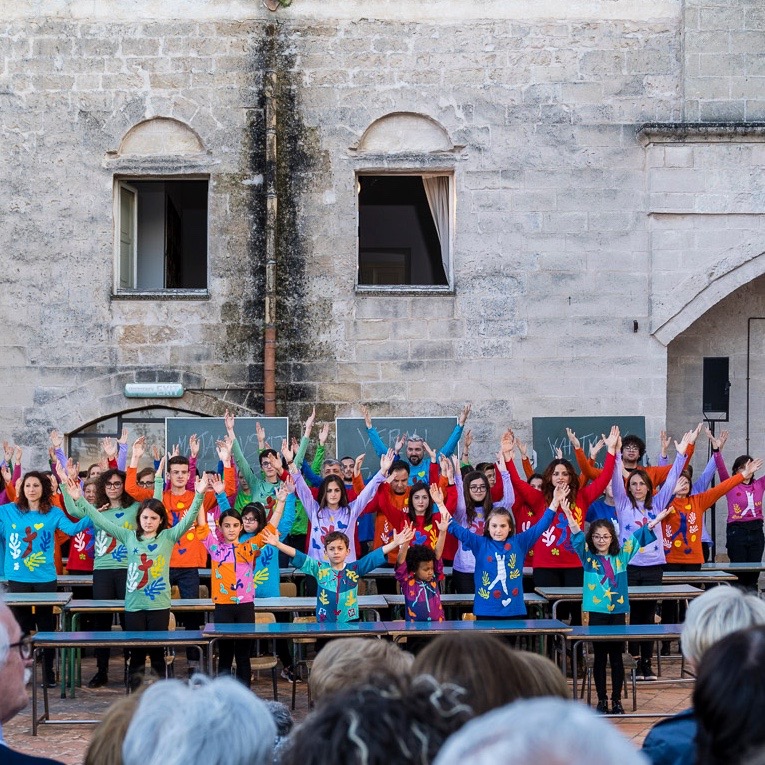
This was not simply a participatory event – it was a journey that made every citizen an integral part of Dante's work.
This was the intention behind 'Purgatorio, a Public Call for 'Divina Commedia, by Dante Alighieri', and this is what it turned out to be. The performance was produced by the Teatro delle Albe and directed by Marco Martinelli and Ermanna Montanari, and involved not just IAC actors from Ravenna and Matera, but above all hundreds of local people. The idea behind the entire project was to construct a performance that would deal with the present, one that aimed to engage with what is happening today. When they took on this colossal work, Martinelli and Montanari decided to make use of to two distinct, yet complementary, theatrical traditions: sacred mediaeval events and the Russian people's theatre of the early twentieth century. It was this approach that provided the power behind the process, and which made it possible to go beyond the classic concept of participation, which can sometimes be bound to what is almost a deliberately amateurish approach, and to attain a fusion between the work and the citizens.
Purgatorio was built around local residents in such a way that they became a vital part of it, and without them it would have had no reason to exist.This is why it was essential to follow the protagonists of the process, to understand their hopes and emotions, and finally to be able to appreciate their development. Four local people of different sexes, ages and origin decided to tell their stories and to have them told during the construction of this collective performance. What emerges from the words of Tiziana, Maurizio, Antonella e Claudio, who joined hundreds of other citizens as part of the chorus of Purgatorio, is the explosive power of chorality, and at the same time the sometimes therapeutic function of the theatre, which has given our protagonists a serene new kind of awareness.
PURGATORIO, the canticle of starting anew on stage in Matera from 17 May to 2 June
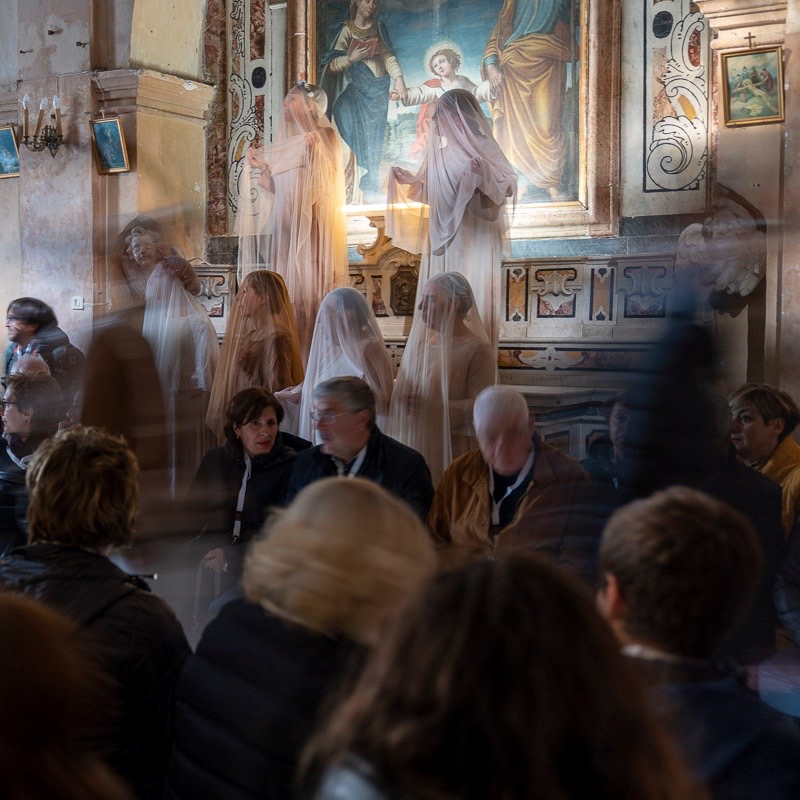
The final curtain has fallen on Purgatorio, a wonderful spectacle that moved the entire community, a collective experience that became an extraordinary artistic production!
Two weeks of planning, 300 citizens directly involved in the performances and a wonderful response from audiences, with all the performances sold out.
The relevance of Dante's Purgatorio to our everyday lives can be found in the human vices and virtues represented in the extraordinary monologues by Ermanna Montanari and Marco Martinelli, the creators, artistic directors and directors of the joint stage event they put together call after call around people of all ages, languages and origins.
From 17 May to 2 June 2019, this splendid artistic production by the Ravenna Festival-Teatro Alighieri with Matera 2019, in collaboration with the Teatro delle Albe-Ravenna Teatro, also involved local theatre companies, including the IAC - Centro Arti Integrate.
Marco Martinelli and Ermanna Montanari's visionary gamble of transforming Dante's masterpiece into a theatrical event involving numerous incursions into important current topics – politics and sociology, and love and hope – was a success, from the intense, heart-breaking scene of women killed violently by their husbands, fathers, boyfriends and brothers to Pia, who becomes every woman in the world, and the final scene, in which four little Greta Thunbergs with pigtails made us think about the fragility of our planet caused by the irresponsibility of adults and those in power.
The show ended with loud applause in Via del Riscatto, the location of the splendid Cappella delle Monacelle and a metaphor for a great, prophetic spiritual rebirth.
The Bread Festival in the Streets of Piccianello
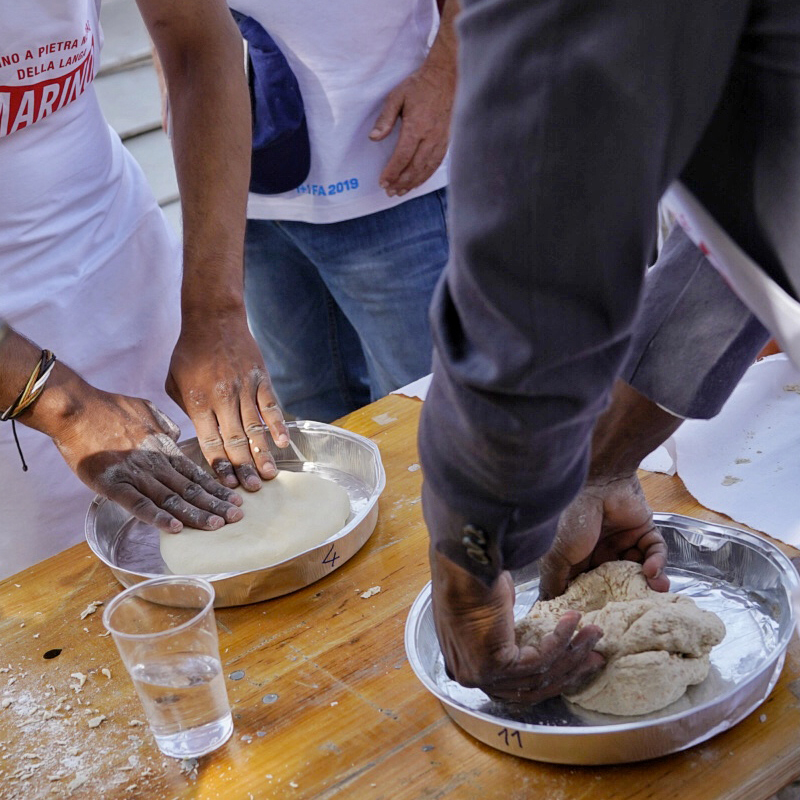
Exhibitions, residencies, artistic performances, cooking classes, workshops and shows – and one single undisputed protagonist: bread.
Breadway, the project co-produced by Murgiamadre, was a journey and an experience through the streets of the Piccianello district reviving the tradition of bread between 6 and 9 June along a route that included bakers, the former mill and other iconic locations of the Rione.
The 'bread festival' united the telling of the story of local traditions with contemporary artistic expression. Temporary citizens and cultural inhabitants were involved together in an immersive experience that brought them closer to a heritage of knowledge and flavours.
Two exhibitions reopened the doors of the former Mulino Alvino, the first mill to be built in Matera at the end of the 19th century. They marked the start of the festival with an exhibition of the work by the students of the IED in Barcelona and the projects that had answered the call launched by ADI to design new kinds of bread.
The students of the European Institute of Design worked on various aspects of breadmaking: from the beginning, starting with the ingredients that make it up, to stale leftovers. Bread that feeds our bodies, bread that becomes a design item and makes it possible for us to try things out and create a new object while also recycling what is left.
The call launched by the Associazione per il Design Industriale in February, on the other hand, invited participants to create and propose new types of bread using a formula that was not limited to the strictly food-related aspect, but looked beyond it, as the great chefs have accustomed us to seeing. Cooks and designers share an extremely free creative process – they are two very closely-related professions, the only difference being that in the former case, the results are ephemeral and usually disappear after a few bites.
Design projects and performances by five international artists and food performers selected by Indisciplinarte both started out from a long creative construction process revolving around the subject of bread.
Rares Augustin Craiut and Xavier Gorgol took us though the Panificio Perrone for a lesson in anatomy in which the body that was being cut up was the bread of Matera, a megaphone of memories of journeys and migrations through stories collected from a call to people who have left the city.
Floriane Facchini & Cie pulled memories of all kinds out of the cupboard, interviewing the inhabitants of Piccianello, whose faces and stories enriched the facades of its houses. For the final Cucine(s) Matera performance, a lively parade led visitors to the various stages of this temporary installation, with bread as its common thread.
With a characteristic mobile bakery, Catalina Pollack Williamson listened to stories from the participants and blended their contents together, starting out from memories and traditions. In the bucolic location of the Chiesa Rupestre di Cristo La Gravinella, Gosie Vervloessem performed a mystic ritual that brought a magical creature to life. Finally, together with Harinera Panem et Circenses, the Chilean Andrea Paz and Colectivo Harinera Site Specific, we relived the ancient tradition of crapiata through a contemporary version.
As well as the performances, there were also numerous workshops, including the Cooking Class run by the Associazione Cuochi Materani Derado Vandemoortele and the Consorzio I.G.P. Pane di Matera, children's workshops run by Cozinha Nomade in the shade of the pine trees in the courtyard of the Scuola Marconi and the collections and archives of Paneuropa, a redesigned map of Europe based on the various types of bread found on the continent.
The warm summer evenings were enlivened by a concert by Musica da Cucina, where utensils become instruments, ska with indie and reggae influences by Skanderground, Route 96's cooking blues show and the swing, jive and Dixieland sounds of the Spaghetti Brothers.
With Breadway, Matera and bread became a symbol of sharing, religiousness, holiness and creativity to create a new informed community. Breadway was a rediscovery of conviviality and the pleasure of being together in the name of bread.
Public call to become a protagonist in ‘Inhabiting the Opera’
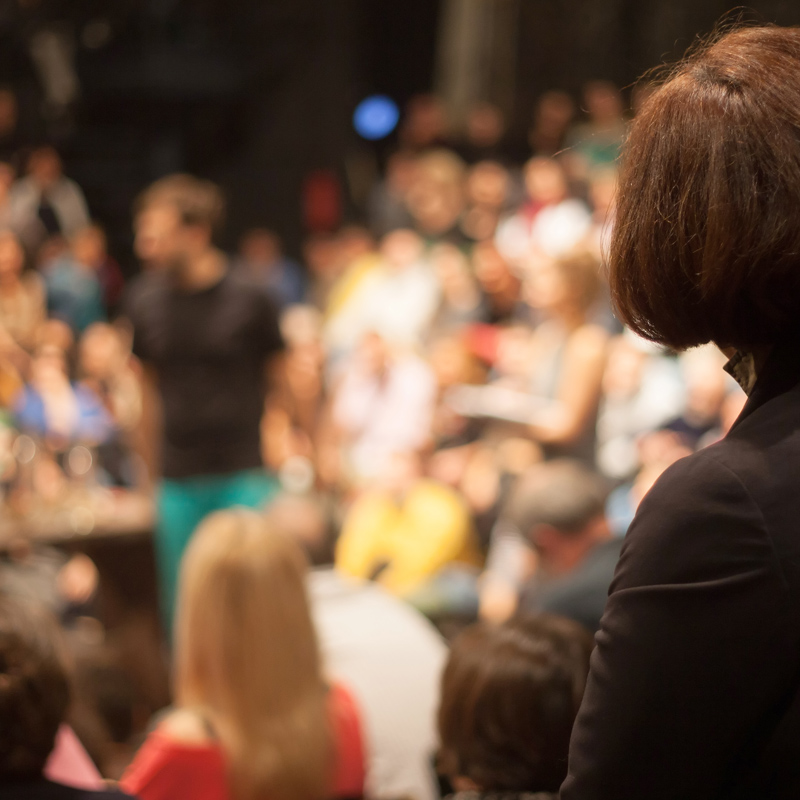
Would you like to become a protagonist in 'Inhabiting the Opera'? We are looking just for you for one of Matera 2019's most highly-anticipated projects, which will be produced in collaboration with one of the world's oldest theatres, the Teatro San Carlo of Naples!
Citizens will be directly involved in the staging of Pietro Mascagni's opera ‘La Cavalleria Rusticana’, which will be set in the Sassi di Matera, an open-air theatre like no other in the world.
The performance will be divided into two parts: the first, which is a travelling show called 'Prologo sui Sassi', or 'The Seven Capitalist Sins', will involve the participation of citizens, and consists of short scenes inspired by the seven deadly sins illustrating the excesses of contemporary neoliberalism, while the second is a production of Pietro Mascagni's opera ‘La Cavalleria Rusticana’, directed by Giorgio Barberio Corsetti, which will be performed in the picturesque setting of Piazza San Pietro Caveoso and the Church of Santa Maria di Idris.
Citizens will be asked to take part in both the scenes of 'The Seven Capitalist Sins' and in some brief crowd scenes in Pietro Mascagni's opera that will require simple theatrical actions, choruses and choral dances. All those wishing to take part in creating the opera will be involved in the following activities: workshops from 17 to 22 June, performance rehearsals from 10 to 30 July, a pre-dress rehearsal on 31 July, a dress rehearsal on 1 August, a first performance on 2 August, and a second performance on 3 August.
The workshop for citizens will be held between 17 and 22 June from 18.00 to 21.00 at the Casale in Via Madonna delle Virtù in Matera.
All citizens may take part in the workshop, based on their own availability.
Rehearsals for the show, which are scheduled to take place at the Teatro Quaroni in the La Martella district in July, will be held no more than three times a week during the afternoon or evening, so that everyone will be able to take part.
If you require further information, please send an e-mail to This email address is being protected from spambots. You need JavaScript enabled to view it., adding ‘ABITARE L’OPERA’ in the subject line.
You must have a Matera 2019 Passport if you wish to participate in this public call.