
27 March 2026
Best wishes for a great start, Matera! The city begins its year as the Mediterranean Capital of Culture and Dialogue

Matera has officially launched its year as the Mediterranean Capital of Culture and Dialogue 2026. The city welcomed around 100 delegations, 80 accredited journalists and hundreds of cultural operators, supported by 110 volunteers. The Opening Ceremony also drew significant online attention, with over half a million views on social media. The final show saw 850 drones light up the sky above the Murgia Park, watched by the entire city from the panoramic viewpoints of the Sassi.
On 20 March, the International Day of Happiness, the heart of the institutional ceremony took place at the construction site of the Teatro Duni. Still under restoration, the theatre was symbolically returned to the city to host Executive Vice-President of the European Commission and European Commissioner for Cohesion and Reforms Raffaele Fitto, Minister for Institutional Reforms and Regulatory Simplification Elisabetta Casellati, European Commissioner for the Mediterranean Dubravka Šuica, President of the Basilicata Region Vito Bardi, Mayor of Matera Antonio Nicoletti, Petra Kežman, Deputy Secretary General of the Union for the Mediterranean, Josep Ferré, Executive Director of the Anna Lindh Foundation and Director General of the Matera Basilicata 2019 Foundation Rita Orlando. Minister of Culture Alessandro Giuli and Deputy Prime Minister and Minister of Foreign Affairs Antonio Tajani joined remotely.
The ceremony opened with the notes of “Mediterraneo” by Lucanian singer-songwriter Pino Mango, accompanying a video directed by Alessandro Rak and produced by Riva Dei Ginepri and Mad Entertainment for MaTiFF – Matera International Film Festival, capturing the essence of a Mediterranean that unites and reassembles memories into new imaginaries.
On scaffolding transformed into a stage, the Matera Symphony Orchestra and the Polifonica Materana Choir performed the Italian National Anthem and Ode To Joy. Architect and urban planner Pietro Laureano delivered a lectio brevis, offering a broad vision of the Mediterranean as a space shaped by stone and water, memory and human relationships.
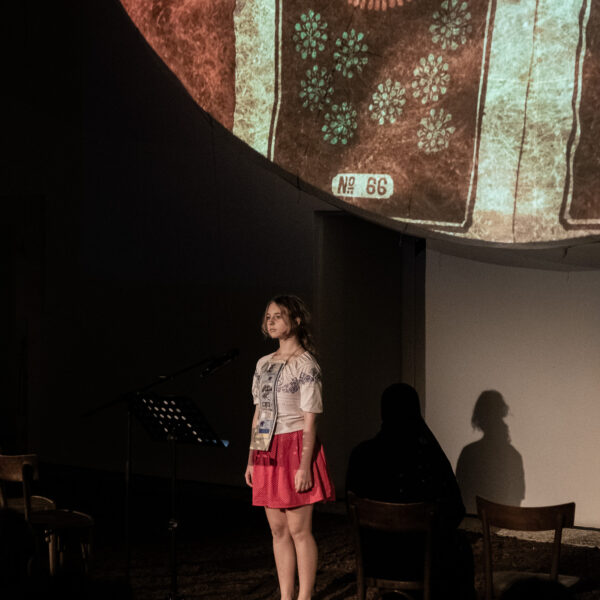
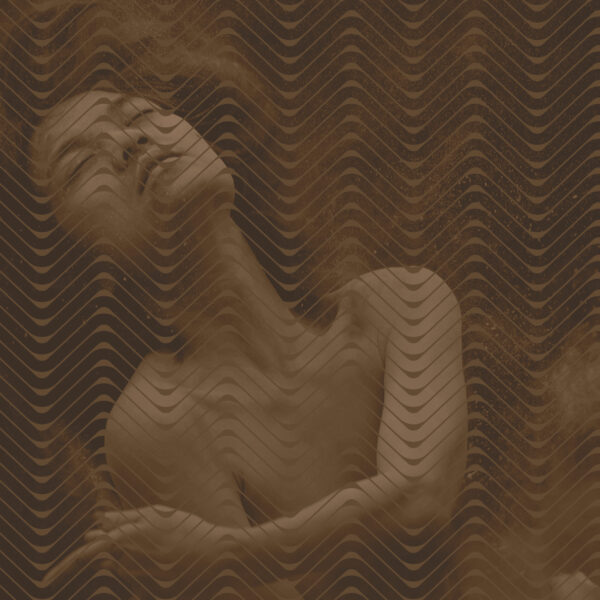
Among the most powerful artistic moments were the choreographic performances by Antonella Albano and Mick Zeni – Principal Dancer and former Principal Dancer of Teatro alla Scala in Milan – performing the duet Anemos. The Breath of the Sea, set to original music by Mattia Vlad Morleo. Actress Eva Danino brought to the stage “Ma patrie est un visage” by Moroccan poet Tahar Ben Jelloun, as a tribute to the twin city of Tétouan. This part of the ceremony concluded with a concert by Eugenio Bennato, featuring “Che il Mediterraneo sia” and “Ninna Nanna 2002”.
The entire city then became a vast open-air stage. On the façade of the Prefecture Palace, Vincenzo D’Alba’s installation Sirena Bicaudata evoked one of the most ancient iconographies of Matera Cathedral, while the Grottole Wind Orchestra – 48 musicians conducted by Maestro Filippo Carretta – performed on the scaffolding. From there, the Strada Evento unfolded across the historic centre: a widespread performance involving 36 dancers, 38 musicians and actions across 45 locations, including balconies, windows and terraces, culminating in Piazza San Pietro Caveoso with a grand finale of light, lasers and drones.
The ceremony concluded with an immersive experience blending art and technology. From Sasso Caveoso, the traditional Mediterranean sounds of Pino Basile, hybridised in real time with the electronic music of Daniele Antezza, were transformed into laser flows across the Murgia Park by Ultravioletto, in a synesthetic universe conceived and directed by Studio Antani. Finally, 850 drones designed luminous architectures in the sky under the direction of Nicola Di Meo.
The programme continued throughout the weekend. As part of the FAI Spring Days on 21 and 22 March, the Teatro Duni construction site was exceptionally opened to the public in tribute to architect Ettore Stella, with guided tours organised by FAI Basilicata and students from the E. Duni – C. Levi Institute in collaboration with Cantiere-evento®. On Saturday morning, the theatre hosted the talk The Future of the Past, featuring artists Vincenzo D’Alba, Domingo Milella and Edoardo Tresoldi, curated by Dioguardi Lab. Among the many sites open to visitors were also the Rupestrian Church of Santa Barbara and San Rocco in Casalnuovo – a symbol of interreligious dialogue – and the Bread Museum, representing a shared cultural heritage of Mediterranean civilizations. The University of Basilicata contributed to the opening weekend with the initiatives of “Università Svelate,” including Urban Explorations in the Borgo La Martella and Lanera districts as part of the FraMMET project, and the Opening Ceremony of the Academic Year of the School of Specialisation in Archaeological Heritage, featuring a lectio by Alfonsina Russo, Head of the Department for the Enhancement of Cultural Heritage at the Italian Ministry of Culture.
On the morning of Sunday 22 March, a Matera 2026 branded hot air balloon, curated by the “Consorzio Landing on South Italy – Mongolfiere al Sud Italia”, was installed at Tramontano Castle Park, offering a striking visual perspective over the city, accompanied by a piano performance by Maestro Rocco Claudio Ferrara. In the coming months, the balloon will tour several Italian cities to promote Matera 2026.
Key to the success of the opening days were the collaborations with local institutions: the Basilicata Region; the Province of Matera, for granting the use of Palazzo Malvinni Malvezzi, where the equipment for the laser show was installed; the Murgia Materana Park, for the performances held on the Murgia; the Prefecture of Matera; the National Museums of Matera, for hosting national and international institutional delegations at Palazzo Lanfranchi; and APT Basilicata, for providing the press room set up for three days at the Infopoint in Piazza Vittorio Veneto, serving the 77 accredited journalists.
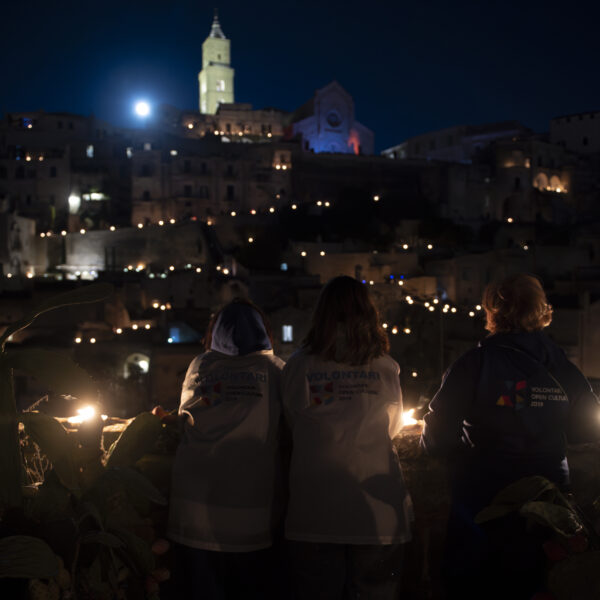
Public safety was also ensured by the widespread presence of numerous law enforcement agencies, while volunteers from the Open Culture 2019 Association, CNGEI, and AGESCI supported all the initiatives.
As highlighted by Rita Orlando, Director General of the Matera Basilicata 2019 Foundation:
“Matera is the vertical archive of the Mediterranean basin, where each layer represents a civilization, a patchwork of Byzantine, Arab and Norman influences. While coastal cities look towards the horizon, Matera preserves its geological and anthropological memory. Here, the Mediterranean is not something to look at, but something to inhabit within layers of tuff. In 2026, we aim to become a route – to remind that the Mediterranean is not a border, but a bridge. Not a line that divides, but a shared breath that unites. Matera positions itself as the place where Europe meets Africa and the East, not for a nostalgic celebration of the past, but to build cultural diplomacy from the ground up, reaffirming that the South is not a periphery, but a centre for new paradigms – a Mediterranean centre of gravity.”
It is only the beginning of a long journey: a year in which the city becomes an open space for encounter, a laboratory of cultural diplomacy and a bridge between Europe, Africa and the Middle East. Matera 2026 is a time to be lived and built together.
VIDEO – LASER AND DRONE SHOW
VIDEO –




FOLLOW US